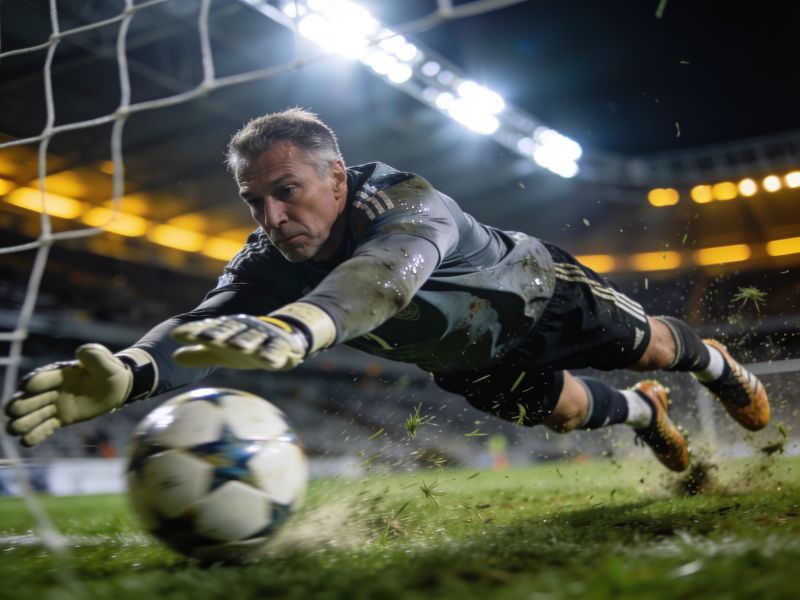
Essam El Hadary was 45 years and 161 days old when he walked out at the Volgograd Arena on 25 June 2018, and by that point nobody was treating the number as a curiosity. Egypt were already eliminated. The only thing left to play for was pride and a line in the record books. In the 41st minute he dived low to his right and pushed away Fahad Al-Muwallad's penalty, and for a few seconds the oldest player in the World Cup looked like the sharpest man in the stadium.The record he broke had a short but crowded history. Faryd Mondragón held it for four years after coming on for Colombia against Japan in 2014 at 43 years and three days。
a substitution that was pure ceremony — his teammates queued up to hug him before the ball was even back in play. Before him, Roger Milla scored against Russia in 1994 at 42, then ran to the corner flag and performed the shimmy he had invented six years earlier in Italy. Peter Shilton was 40 in 1990 when England lost on penalties to West Germany, a night he probably still replays in his head. Stanley Matthews was 39 in 1954, which in that era of heavier balls and harder pitches was roughly equivalent to being 45 today. Read that list again and the shape of it is hard to miss: three goalkeepers and one forward, with Milla the only outfield exception in more than sixty years.El Hadary's route there was longer than most. Born in 1973 in a village in the Nile Delta, he spent the bulk of his club career at Zamalek。won four Africa Cup of Nations titles with Egypt, and collected 159 caps — more than any other Egyptian player. He retired from international football in 2013, then unretired. At 41 he moved to Al Taawoun in Saudi Arabia, which is not where ageing legends usually go to wind down, and kept playing anyway. Héctor Cúper brought him to Russia as a third-choice keeper, a veteran presence for a squad that had not reached a World Cup since 1990. He got one match. He saved one penalty. Saudi Arabia still won 2-1, which is the kind of detail that ruins a tidy narrative and makes it feel true.Why goalkeepers?The answer is less romantic than it sounds. A striker's game is built on explosive acceleration, and that is the first thing to go. A keeper's game is built on angles。anticipation, positioning and talking — skills that sharpen with repetition. El Hadary had faced thousands of penalties in training. He read Al-Muwallad's hips before the ball was struck. Add the fact that squads carry three keepers and only one plays, and a veteran can sit on a bench for a month, stay useful in sessions, and step in when a younger man is hurt or the group is already out. The oldest player in the World Cup is almost always a goalkeeper because it is the one position where the mind can partly cover for the legs.
Qatar 2022 skewed old in a different way. Guillermo Ochoa was 37, Dani Alves and Pepe were 39。Cristiano Ronaldo was 37 and starting knockout matches rather than making cameo appearances, which suggests the boundary is drifting. The expanded 48-team tournament in 2026 will hand out more places and larger squads, and somebody will push the mark again. Whether that matters is debatable. El Hadary's record is a footnote and he seems to know it;
he has said the save meant more to him than the statistic. Still, there is something worth keeping in it. Longevity in football is not about refusing to age. It is about finding the version of the game your body can still play, and then playing it well enough that nobody bothers to argue.